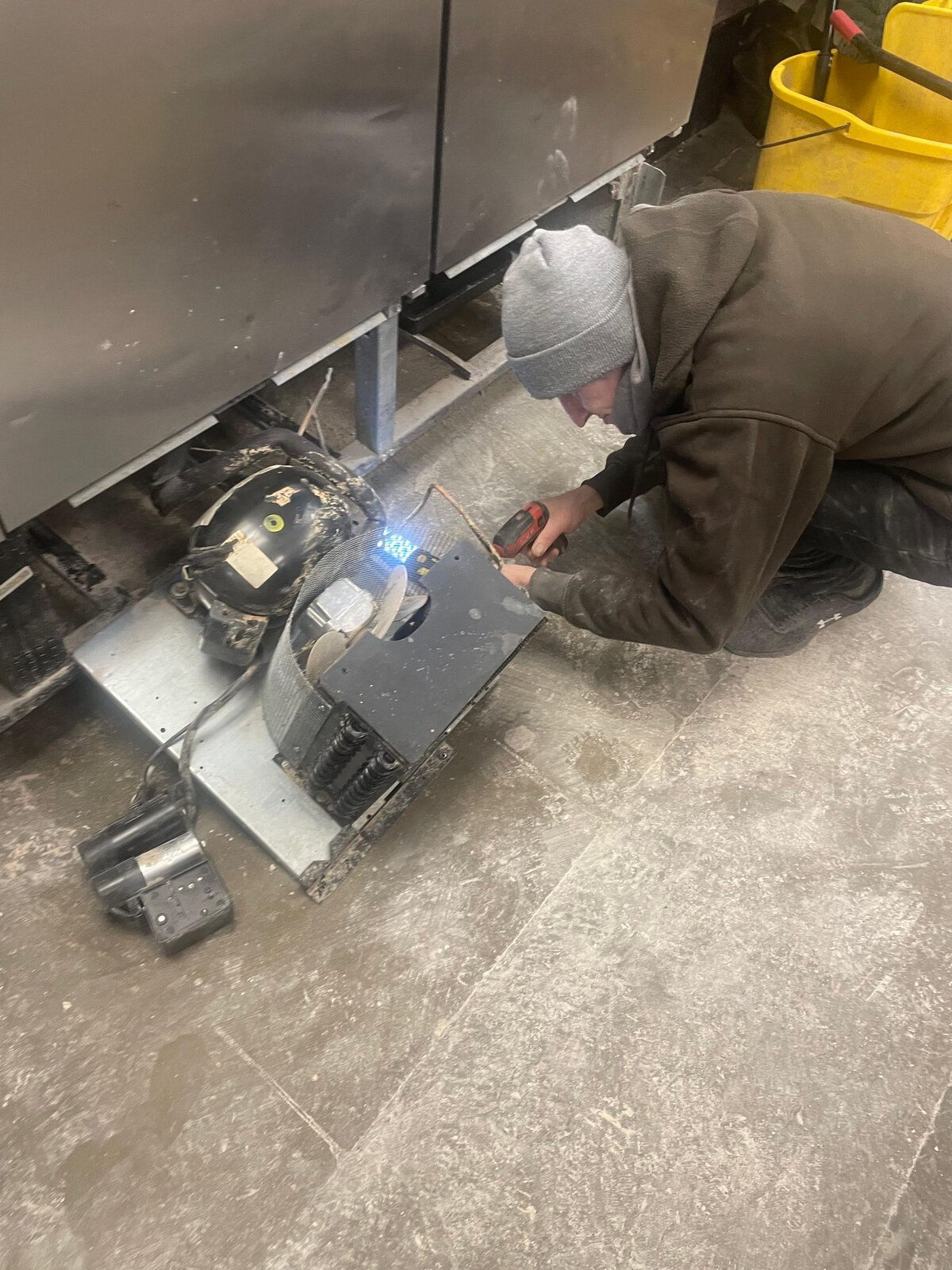
Look, we’ve all been there. You get home from the grocery store, you’re tired, and you just shove the milk in the fridge and the frozen peas in the freezer. Door shuts, you move on. But here in Montgomery County, where our summers swing from muggy to sweltering and our winters can be unpredictable, that casual approach to your fridge and freezer temperatures isn’t just about food tasting good. It’s a genuine food safety gamble. And it’s one we see homeowners lose far too often.
Key Takeaways:
- The “danger zone” for bacterial growth is 40°F to 140°F. Your refrigerator must consistently stay at or below 40°F, with 37°F being the ideal target.
- Freezers must maintain 0°F to safely preserve food quality and safety long-term.
- Inconsistent temperatures, often caused by aging appliances, faulty seals, or simple neglect, are a leading cause of foodborne illness at home.
- For local homeowners, our climate and the age of many homes in areas like Silver Spring add unique challenges to maintaining these critical temperatures.
So, what’s the magic number? It’s not a range; it’s a target.
Your Refrigerator Should Be at 37°F. Not “around 40,” but 37. This gives you a crucial buffer. When you open the door on a 95-degree day in Rockville, humid air rushes in. The compressor kicks on, but if your thermostat is already set at 40, the interior temperature can easily spike into the danger zone before it recovers. 37°F is your safety margin.
Your Freezer Must Be at 0°F. This isn’t just for making ice cubes hard. At 0°F, microbial growth is completely halted, and food retains its nutritional value and texture for much longer. If your freezer is reading 10°F or 15°F, you’re in a “holding pattern” where food is slowly degrading, and you’re burning more energy to do a subpar job.
We’ve answered service calls in Bethesda homes where a $500 grocery haul was ruined because an old fridge’s compressor was cycling poorly, slowly letting the temperature creep up. The owner didn’t smell or see anything wrong until it was too late. The cost of a service call to diagnose that issue is always less than replacing that load of food—not to mention avoiding a nasty case of food poisoning.
Table of Contents
The Hidden Cost of “Close Enough”
The biggest misconception we combat is that a slightly warm fridge just means your lettuce wilts faster. The real issue is invisible. Bacteria like Listeria and E. coli don’t make a fuss. They quietly multiply in that danger zone. You can’t see, smell, or taste most of them. By the time you eat that seemingly fine leftover chicken, the population of pathogens has potentially grown to dangerous levels.
This risk is amplified in our older, charming neighborhoods like Takoma Park or downtown Silver Spring. Many homes have original kitchens from the 50s, 60s, and 70s. The electrical outlets aren’t always grounded perfectly, leading to voltage fluctuations that modern, sensitive appliance electronics hate. The cabinetry is tight, causing poor ventilation around the fridge, making the compressor work harder and run hotter. It’s a perfect storm for temperature inconsistency.
Why the Thermostat Dial is a Liar
That dial inside your fridge with numbers 1 through 5, or a slider from Cold to Colder? It’s virtually meaningless. Those are arbitrary settings, not temperature readings. The only way to know what’s happening inside your appliance is with a standalone, calibrated appliance thermometer. Put one in a glass of water in the center of the fridge (the air near the door is always warmer). Put another between frozen food packages in the freezer.
Check them weekly. If you see the fridge reading 42°F or the freezer at 10°F, you have a problem. Often, it’s a simple fix like cleaning the condenser coils (those dusty coils on the back or bottom of the unit—a huge energy suck when dirty). Sometimes, it’s a worn door gasket you can feel cold air leaking from. But sometimes, it’s a sign of a failing compressor or a refrigerant leak.
When DIY Stops and Professional Help Begins
You’ve cleaned the coils, checked the seal, verified the temperature with a good thermometer, and it’s still not holding. Now what? This is the threshold we see daily. If your unit is over ten years old and struggling to maintain temperature, you’re facing a decision: repair or replace.
Modern refrigerators are vastly more efficient but contain complex circuit boards and sealed refrigerant systems. This is where a professional diagnosis is worth every penny. A technician can measure the actual refrigerant pressure and compressor performance, not just the symptom (warm temperature).
For instance, if a system is low on refrigerant (due to a slow leak), simply adding more is illegal and ineffective without first finding and repairing the leak. The EPA’s Section 608 regulations mandate that technicians handling refrigerant be certified to prevent environmental release. A pro will find the leak, repair it, evacuate the system, and recharge it to the manufacturer’s exact specification—that’s what restores precise temperature control.
Trying to bypass this with a “quick charge” from an uncertified handyman will cost you more in the long run, damage the environment, and likely leave you with the same problem in a few months.
The Local Reality: Climate, Power, and Old Houses
Let’s talk about our specific context. Montgomery County’s humidity is a condenser coil’s worst enemy. Dust and pet hair combine with moisture to create a thick, insulating mat that coats the coils. This makes the compressor run longer and hotter, struggling to shed heat. It’s the number one cause of premature compressor failure we see, especially in homes with pets near Rock Creek Park.
Furthermore, summer thunderstorms can cause micro-surges that knock out the delicate control boards in newer fridges. A whole-house surge protector is a wise investment, but if your fridge suddenly goes warm after a storm, the culprit is often electronic, not mechanical.
Here’s a practical table based on what we commonly find in local homes:
| Symptom You Notice | Possible DIY Fix | Likely Professional Issue | When to Call Someone Like Us |
|---|---|---|---|
| Fridge is warm, freezer is fine. | Check for blocked vents inside, ensure fan is running. | Failed evaporator fan motor in fridge compartment, or a defrost system fault. | If the fan isn’t running or DIY checks don’t work. The defrost system requires technical diagnosis. |
| Freezer is warm, fridge is warm. | Clean condenser coils thoroughly. Check thermostat setting. | Low refrigerant charge (leak), failing compressor, or a clogged capillary tube. | Immediately. This is a major system failure. |
| Fridge is too cold, freezing items. | Adjust thermostat (knowing it’s imprecise). Check if thermometer is in airflow from freezer. | Faulty damper control letting too much cold air into fridge, or a stuck cold control thermostat. | If adjustment doesn’t help. Parts need testing and replacement. |
| Cycling on/off constantly. | Ensure there’s 2+ inches of clearance around the unit for airflow. | Faulty start relay or overload protector on the compressor, or a serious refrigerant issue. | If improved airflow doesn’t solve it. A bad relay will burn out your compressor. |
| Water pooling inside or underneath. | Clear clogged defrost drain with warm water and a turkey baster. | Internal leak from a cracked water line (for ice makers) or a frozen/clogged drain line deep in the unit. | If clearing the visible drain doesn’t stop it. Internal leaks can cause significant damage. |
The Bottom Line on Safety and Savings
Precise temperature control is the unsung hero of your kitchen. It’s a food safety necessity, a waste-prevention strategy, and an energy-efficiency play all in one. An appliance running 5 degrees too warm is working harder to stay warm, using more electricity to perform poorly.
If you take one thing from this, let it be this: Buy two appliance thermometers. Trust them, not the dial. Monitor them. That simple habit will tell you more about your appliance’s health than anything else.
And when those thermometers start telling you a story of inconsistency, listen. For a local homeowner, a quick consultation with a trusted professional can clarify whether you’re looking at a $200 fix or a $2,000 replacement. We’ve helped countless folks in Silver Spring and across the county make that call with clear, honest information—because no one should have to guess about the safety of their food.
[
  {
    "@context": "https://schema.org",
    "@type": "Article",
    "headline": "Why Precise Temperature Control Is Critical For Food Safety In Montgomery County",
    "description": "A practical guide to refrigerator and freezer temperature safety, common failures, and when to seek professional help, grounded in real-world experience serving Montgomery County, MD.",
    "author": {
      "@type": "Organization",
      "name": "Pavel Refrigerant Services"
    },
    "publisher": {
      "@type": "Organization",
      "name": "Pavel Refrigerant Services",
      "logo": {
        "@type": "ImageObject",
        "url": "((INSERT LOGO URL))"
      }
    },
    "datePublished": "((INSERT PUBLICATION DATE))",
    "dateModified": "((INSERT MODIFICATION DATE))",
    "mainEntityOfPage": {
      "@type": "WebPage",
      "@id": "((INSERT POST URL))"
    },
    "image": {
      "@type": "ImageObject",
      "url": "((INSERT FEATURED IMAGE URL))"
    },
    "url": "((INSERT POST URL))",
    "@id": "((INSERT POST URL))"
  },
  {
    "@context": "https://schema.org",
    "@type": "Table",
    "name": "Common Refrigerator/Freezer Problems & Solutions for Homeowners",
    "description": "A breakdown of common temperature control symptoms, potential causes, and guidance on when DIY is appropriate versus when to call a professional technician.",
    "about": "Troubleshooting home refrigerator and freezer temperature issues"
  }
]
Related Articles
Understanding Critical Violations During A Montgomery County Health Inspection
Regulatory Importance Of Proper Temperature Control In Food Handling
Do Restaurants Receive Advance Notice Of Health Inspections In Maryland
FDA Guidelines For Temperature Monitoring In Commercial Food Storage
DC Food Truck Refrigeration: Unique Maintenance Needs
People Also Ask
Temperature control is a critical part of food safety because it directly prevents the growth of harmful bacteria. The "danger zone" for food is between 40°F and 140°F, where pathogens can double in number in as little as 20 minutes. Proper refrigeration keeps cold foods below 40°F, while hot holding must maintain temperatures above 140°F to stop bacterial proliferation. For commercial kitchens, this is especially important for perishable items like dairy, meat, and prepared dishes. If your refrigeration or freezer equipment fails, Pavel Refrigerant Services can provide prompt repair to ensure your cold storage stays within safe parameters, protecting your customers and your business from foodborne illness risks.
Temperature control is critical because even minor fluctuations can compromise food safety, accelerate spoilage, and cause significant financial losses. In commercial refrigeration, maintaining a consistent temperature prevents bacterial growth and ensures compliance with health regulations. For a deeper understanding of how to address sudden temperature drops, refer to our internal article Commercial Walk-In Freezer Temperature Drop in Potomac: Causes, Diagnostics, and Emergency Repair Solutions. At Pavel Refrigerant Services, we emphasize that proper diagnostics and prompt repairs are essential to avoid costly downtime and product waste.
The critical temperature for food safety is 41 degrees Fahrenheit (5 degrees Celsius) for cold food and 135 degrees Fahrenheit (57 degrees Celsius) for hot food. This range, known as the temperature danger zone, is where bacteria grow most rapidly. For commercial kitchens, maintaining these thresholds is essential to prevent foodborne illness. If your establishment in the DMV Metro Area requires refrigeration or freezer maintenance to ensure consistent temperature control, Pavel Refrigerant Services can provide expert system checks and repairs. Proper calibration and upkeep of your equipment are key to staying compliant with health codes.
Hot holding temperature control for safety food at 135F or higher is critical to prevent the rapid growth of harmful bacteria. When food is kept below this threshold, pathogens such as Salmonella and Listeria can multiply quickly, leading to foodborne illness. Maintaining this temperature ensures that any existing bacteria are inactivated or kept from reaching dangerous levels. For commercial kitchens in the Washington D.C. and Silver Spring area, strict adherence to this standard is a key part of health code compliance. At Pavel Refrigerant Services, we emphasize that proper hot holding not only protects public health but also helps avoid costly violations and food waste. Consistent temperature monitoring and reliable equipment are essential to achieving this safety goal.
The Montgomery County Health Department does not publish a single universal fee schedule, as costs vary by permit type and establishment. For food service facilities, fees typically cover initial plan review, annual permits, and reinspections. Specific charges depend on the risk level of the operation, such as full-service restaurants versus limited food vendors. It is important to note that fees are subject to annual adjustment by the county. For a complete breakdown of current costs, you should consult the official Montgomery County website. Additionally, understanding the inspection process is crucial for budgeting. For more context on how inspections are conducted, please see our internal article Do Restaurants Receive Advance Notice Of Health Inspections In Maryland.
For mobile food operations in Washington D.C., Silver Spring, and the surrounding DMV Metro Area, a valid mobile food license is required by local health departments. This license ensures your vehicle meets sanitation, refrigeration, and food safety standards. Pavel Refrigerant Services can help you maintain proper refrigeration temperatures to comply with these regulations. Regular inspections of your cooling systems are critical to avoid license violations. Additionally, you must display your license visibly and renew it annually. Always check specific requirements with the D.C. Department of Health or Montgomery County authorities, as rules can vary by jurisdiction within the DMV.