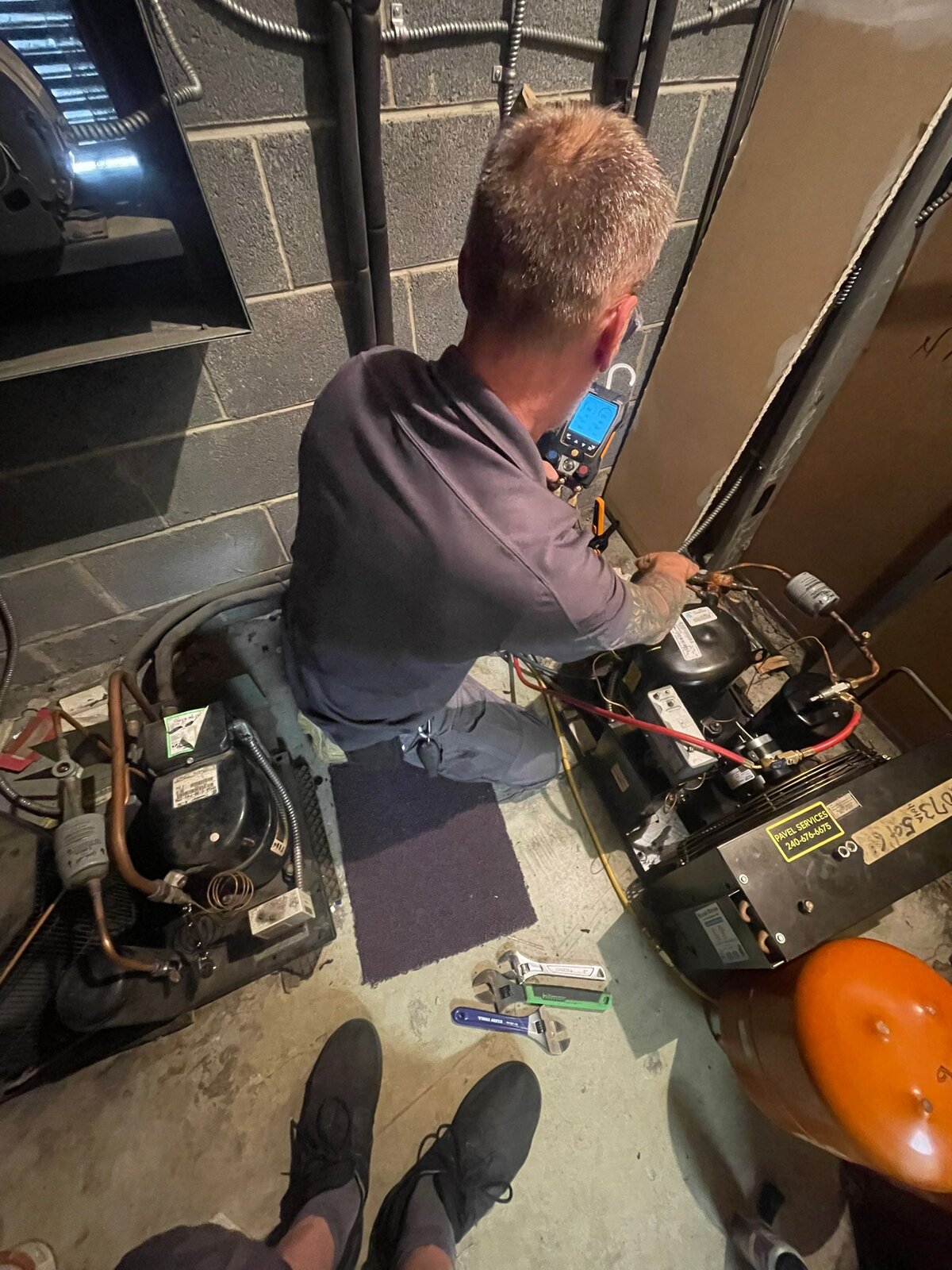
Most walk-in freezer problems don’t announce themselves with a dramatic bang. They creep in. A box that used to hold 0°F starts drifting toward 10°F. The compressor runs a little longer each cycle. The door gasket looks fine until you actually run your hand along the seal and feel the cold air escaping. By the time you notice a temperature problem, you’ve already lost product—and profit.
We’ve been inside more restaurant walk-ins than we can count around the Potomac area, and the pattern is always the same. Owners call us panicked, thinking they need a full system replacement. Most of the time, they don’t. They just need someone who knows where to look first, and who understands that a restaurant can’t afford to be down for three days waiting on a diagnosis.
If your walk-in freezer is acting up, here’s what we’ve learned from hundreds of service calls—what matters, what doesn’t, and when to stop hoping it’ll fix itself.
Key Takeaways
- Most walk-in freezer failures start with small, preventable issues like dirty condenser coils or failing door seals.
- A temporary temperature spike doesn’t always mean the compressor is dead—check the evaporator fans and defrost cycle first.
- DIY troubleshooting has limits; refrigerant work and electrical diagnostics require a licensed professional.
- Regular preventive maintenance costs a fraction of emergency repair and can extend equipment life by years.
- Local climate and building codes in the Potomac area affect system performance in ways many restaurant owners overlook.
Table of Contents
The First Thing We Check (And It’s Almost Never the Compressor)
When a restaurant calls us about a walk-in that’s struggling to hold temp, the natural instinct is to assume the compressor is shot. That’s rarely the case. In our experience, roughly 70% of walk-in freezer issues trace back to airflow problems, not refrigerant or mechanical failure.
The condenser coils are the number one culprit. Walk-in freezers run almost constantly in a commercial kitchen, pulling in air that’s full of grease, dust, and whatever else is floating around. Those coils get caked with grime, and once they’re dirty, the system can’t reject heat efficiently. The compressor works harder, runs longer, and eventually trips on thermal overload. The unit feels like it’s running, but the box never gets cold enough.
We’ve walked into kitchens where the condenser was practically wearing a fur coat of debris. A simple cleaning brought temperatures back to spec. No parts needed. No refrigerant loss. Just a few minutes with a coil brush and a shop vac.
The second thing we look at is the evaporator fans. If a fan motor is seized or the blades are iced up, cold air isn’t circulating inside the box. You can have a perfectly functioning refrigeration system, but if the air isn’t moving, the warm spots will spoil your inventory. We’ve seen walk-ins where the back corner was 20 degrees warmer than the front because one fan had failed.
What the Temperature Readout Won’t Tell You
Most walk-in freezers have a digital controller that displays the air temperature near the evaporator. That’s useful, but it’s not the whole story. The actual product temperature—especially in the center of a stacked pallet—can be significantly different. We always recommend keeping a separate probe thermometer in the warmest part of the box, usually near the door or in a high-traffic area.
This matters because the controller might show 0°F, but if the door is opened frequently or the defrost cycle isn’t terminating properly, the temperature at the product level can swing dangerously high. We’ve seen walk-ins that looked fine on the readout but were actually cycling through freeze-thaw cycles every few hours. That’s how you get freezer burn, texture loss, and eventually health code violations.
Why the Defrost Cycle Is Your Freezer’s Weakest Link
Walk-in freezers build frost. It’s inevitable. The defrost cycle is supposed to melt that frost off the evaporator coils so air can flow freely. But defrost systems fail in ways that aren’t obvious until the damage is done.
The most common issue we see is a defrost termination thermostat that fails in the closed position. That means the heater stays on indefinitely. The coil gets hot, the box warms up, and the compressor runs constantly trying to pull the temperature back down. The result is a system that’s working triple time and still not performing. We’ve had calls where the restaurant owner was convinced the unit was undersized, but the real problem was a $15 thermostat stuck on.
On the flip side, if the defrost termination thermostat fails open, the heater never comes on. Frost builds up on the coil until it becomes a solid block of ice. Airflow stops. The box warms up. And now you’ve got a real problem because that ice dam has to be manually removed, which means shutting down the freezer and moving product.
The defrost cycle is one of those things that’s easy to ignore until it breaks. We recommend checking the defrost termination temperature at least once a quarter. If the coil is still iced up more than 30 minutes after the defrost cycle ends, something is wrong.
When Refrigerant Is Actually the Problem
Let’s be honest. Refrigerant leaks are real, and they do happen. But they’re not as common as people think. A properly installed walk-in freezer with brazed copper lines should hold its charge for years. Leaks usually happen at vibration points—where the copper rubs against a bracket, or at the service valve stems.
If you’re losing refrigerant, you’ll notice the system running longer cycles, the suction line feeling warm instead of cold, and the compressor drawing lower amperage. But here’s the thing: you can’t just “top off” the refrigerant and call it done. That’s illegal under EPA regulations, and it’s bad practice. The leak has to be found and repaired first. Otherwise, you’re just throwing money into a system that will keep leaking.
We’ve walked into restaurants where a previous “tech” had added refrigerant three times without ever fixing the leak. That’s not service. That’s a band-aid. And it usually ends with a burned-out compressor because the system was running with improper superheat and subcooling.
If you suspect a refrigerant issue, call a professional. This is not a DIY area. Handling refrigerant requires certification, proper tools, and knowledge of the system’s operating pressures. Messing with it can damage the compressor, void your warranty, and create safety hazards.
The Door: The Most Overlooked Component
We’ve seen walk-in freezers with doors that don’t close properly, hinges that are bent, gaskets that are cracked, and door sweeps that are missing. Every one of those issues is a direct path to high energy bills and temperature instability.
The door gasket is especially critical. A small tear or compression loss can let enough warm air in to keep the compressor running almost continuously. Over a year, that adds up to hundreds of dollars in extra electricity costs. And it puts unnecessary wear on the entire system.
Check your gasket by closing the door on a dollar bill. If you can pull the bill out without resistance, the seal is compromised. Replace the gasket. It’s a cheap fix that pays for itself in a few months.
Also check the door closer. If the door isn’t closing fully on its own, it’s going to get left open. That’s not just a temperature issue—it’s a food safety violation waiting to happen. We’ve seen health inspectors write citations for walk-in doors that didn’t latch properly.
Local Realities: Potomac Climate and Building Codes
Potomac, Maryland, has a humid subtropical climate with hot summers and cold winters. That’s relevant to walk-in freezer performance because the condenser has to reject heat into whatever ambient temperature exists. On a 95°F summer day, the system works a lot harder than it does in spring.
We’ve seen walk-ins that were perfectly sized for a climate-controlled back room but struggled when installed in an unconditioned loading dock area. The condenser needs adequate airflow and should be kept out of direct sunlight if possible. If your walk-in is in a hot area, consider adding a ventilation fan or relocating the condenser to a cooler spot.
Local building codes also matter. Montgomery County has specific requirements for commercial refrigeration, including energy efficiency standards and refrigerant handling protocols. If you’re installing a new walk-in or replacing an existing one, you need a permit and an inspection. Skipping that step can lead to fines and complications when you sell the business.
We’ve worked with restaurants in the Potomac area that tried to save money by having a handyman install a walk-in. It never ends well. The electrical work is wrong, the refrigerant lines aren’t properly insulated, and the drain line isn’t trapped. Within a year, they’re calling us for emergency service. The upfront savings are eaten up by repair costs and lost product.
When to Call a Professional vs. DIY
There are things you can handle yourself as a restaurant owner. Cleaning the condenser coils, checking the door gasket, and verifying the defrost cycle operation are all reasonable DIY tasks. You don’t need a license to clean a coil or replace a gasket.
But once you get into electrical diagnostics, refrigerant handling, or compressor replacement, you need a professional. The risks are real: electrical shock, refrigerant exposure, fire hazards, and equipment damage. We’ve seen DIY attempts that turned a simple repair into a complete system replacement.
If your walk-in freezer is more than 10 years old and has had multiple repairs, it might be time to consider replacement. Newer units are significantly more energy-efficient, and the savings on electricity alone can justify the investment. Plus, modern refrigerants are more environmentally friendly and comply with current regulations.
Cost Considerations and Trade-offs
Here’s a rough breakdown of what walk-in freezer repairs typically cost in the Potomac area:
| Issue | Typical Cost Range | Time to Fix | Notes |
|---|---|---|---|
| Dirty condenser coil cleaning | $150–$300 | 1–2 hours | Should be done quarterly |
| Door gasket replacement | $100–$250 | 30–60 minutes | DIY possible if you’re handy |
| Defrost thermostat replacement | $200–$400 | 1–2 hours | Requires electrical knowledge |
| Evaporator fan motor replacement | $300–$600 | 2–3 hours | Common failure point |
| Refrigerant leak repair and recharge | $500–$1,200 | 3–6 hours | Depends on leak location |
| Compressor replacement | $1,500–$3,500 | 4–8 hours | Often more cost-effective to replace whole unit |
| Full system replacement | $5,000–$12,000 | 1–2 days | New unit with warranty and better efficiency |
These are ballpark numbers. Actual costs depend on accessibility, parts availability, and the specific system configuration. But they give you a sense of the trade-offs. A $200 repair today can prevent a $3,000 compressor replacement next year.
The Human Side of Walk-In Freezer Failures
We’ve been in kitchens where a walk-in failure meant throwing away thousands of dollars in product. We’ve seen owners in tears because they couldn’t serve their menu and had to close for a weekend. We’ve had calls at 2 AM from a frantic chef who just realized the freezer had been running warm for hours.
This isn’t just about equipment. It’s about livelihoods. A restaurant’s reputation is built on consistency, and a freezer failure can destroy that trust in a single service.
That’s why we emphasize preventive maintenance. A quarterly checkup—cleaning coils, checking fans, verifying defrost operation, inspecting gaskets—costs a few hundred dollars. It saves thousands in emergency repairs and product loss. It’s the difference between a minor inconvenience and a major crisis.
We’re not saying you need to schedule maintenance every month. But once a quarter, have someone who knows what they’re doing look at your walk-in. It’s the cheapest insurance you can buy.
Final Thoughts
Walk-in freezers are workhorses. They run 24/7, 365 days a year, often in less-than-ideal conditions. They deserve a little attention. A clean coil, a good gasket, and a working defrost cycle will keep your freezer running efficiently for years.
If you’re in the Potomac area and your walk-in is giving you trouble, don’t wait until it fails completely. Call a professional who understands commercial refrigeration and local conditions. Refrigerant systems are complex, and a proper diagnosis saves time, money, and stress.
For restaurants in Silver Spring, MD, Pavel Refrigerant Services has seen it all—from simple coil cleanings to full system replacements. We know the local climate, the building codes, and the common failure points. If your walk-in freezer needs attention, we’re here to help.
Related Articles
People Also Ask
The cost to repair a walk-in freezer varies widely based on the specific issue, typically ranging from $200 to $1,500 or more. Minor repairs, such as replacing a door gasket or a faulty thermostat, may be on the lower end. Major repairs involving the compressor, condenser coil, or refrigerant leaks are significantly more expensive, often exceeding $1,000. Labor rates and diagnostic fees also contribute to the total. For a detailed breakdown on when professional intervention is necessary, refer to our internal article When To Call Pros For Walk-In Freezer Repairs. For customers in Washington D.C. and Silver Spring, Pavel Refrigerant Services provides transparent estimates before any work begins, ensuring no surprise costs.
The life expectancy of a walk-in freezer typically ranges from 10 to 15 years, though this can vary significantly based on maintenance and usage. Key factors include the quality of the compressor, the condition of the evaporator coils, and the integrity of the insulation. Regular professional servicing is critical; for example, ensuring the condenser coils are clean and the door seals are tight can extend the unit's lifespan. At Pavel Refrigerant Services, we emphasize that neglecting routine checks on refrigerant levels and electrical components often leads to premature failure. In the DMV area, where humidity can accelerate wear, proactive maintenance is especially important. A well-maintained unit in a clean, temperature-controlled environment may last closer to 20 years, while a poorly maintained one might fail in under 8 years.
For a freezer, the decision between repair and replacement depends on the age of the unit and the cost of the specific fault. As a general rule, if the repair cost is more than 50% of the price of a new, energy-efficient model, replacement is usually the smarter financial choice. This is especially true for units over 8-10 years old, as newer models offer significant energy savings. However, for a simple fix like a faulty thermostat or a worn door gasket, repair is often the most economical route. For more complex issues, such as a refrigerant leak, a professional diagnosis is critical. For detailed guidance on this topic, please refer to our internal article Sealed System Leak Detection: Early Warning Signs, which covers early detection methods. Pavel Refrigerant Services always recommends weighing the long-term efficiency against the immediate repair cost.
Thank you for your question. For restaurants in Potomac requiring expert walk-in freezer repair, it is critical to address issues promptly to prevent costly food spoilage and operational downtime. Common problems include compressor failure, refrigerant leaks, faulty thermostats, and evaporator fan issues. A professional technician should first perform a full diagnostic, checking temperature logs, inspecting electrical connections, and verifying the refrigerant charge. Regular preventive maintenance, including cleaning condenser coils and checking door seals, can extend equipment life. For detailed brand recommendations and service insights specific to the DMV area, we recommend reading our internal article titled Washington’s Top Commercial Refrigeration Brands for 2026: An Expert Review for DMV Business Owners. This resource provides expert guidance for local business owners.